
Junior Virginia Johnson thought she knew what courses she would take in high school.
“I wanted to do an AP History track,” Johnson said, “but they kind of pressured me into taking AP Government sophomore year.”
Johnson’s plan was dismantled when Loudoun Valley became one of the first two International Baccalaureate high schools in Loudoun County Public Schools.
To graduate with an Advanced Studies Diploma from a Virginia high school, students are required to complete social studies classes in three disciplines: World History, U.S. History and U.S. Government.
Most students considering the IB track take AP World History freshman year, satisfying the World History requirement.
All Valley IB Diploma students will take two years of IB History of the Americas. Because this is a U.S. History course, IB Diploma students must take AP U.S. Government their sophomore year to satisfy the discipline requirements of the Virginia Advanced Studies Diploma.
Johnson wanted to keep the option of taking the IB Diploma program open. So she took AP Government her sophomore year. Because of her course selection, Johnson now takes IB History of the Americas and will continue to do so through her senior year.
“I could have done AP U.S. History and AP Human Geography, but then it would be mixed grade levels, and I wasn’t feeling that,” Johnson said. “So I’m on an IB track for history now, which I do enjoy.”
Johnson doesn’t find the IB classes she takes particularly difficult, but still doesn’t love them.
“I just feel like there’s a lack of structure,” Johnson said. “I like how much writing we do, but otherwise I feel like I’m not learning as much as I would in an AP class.”
Courses Lost for the IB Program
Johnson isn’t the only student who has experienced an overhaul of their course plans because of the IB program at Valley.
With a current enrollment of 1,112 students, Valley is the smallest high school in Loudoun County. Yet it offers an extensive number of electives and specialized courses to that relatively small student body.
So competition among courses to exist into the next school year is cutthroat. Administration has to remove courses each year if they’re not able to fill classes.
While Valley students are offered a wide variety of electives to take in fine arts, Career and Technical Education, English and other departments, the abundance of choices isn’t sustainable.
AP courses dissolved at the implementation of the IB program in the 2023-24 school year. Most affected was the science department. AP Chemistry lost in favor of IB Chemistry, AP Biology for IB Biology and AP Physics for IB Physics.
Most recently, this is the last year Valley will offer students the opportunity to take AP English Literature. The encouragement to enroll in IB English drove down the number of students selecting the AP course.
This reflects a major mismatch with national trends. Out of the 42 currently offered AP courses, AP Literature ranks third in popularity in national registrations with 415,245 students. It falls only behind AP English Language and AP U.S. History. But at the introduction of the IB English, the AP course lost its popularity at Valley.
“AP Literature, over the last five years, has been decreasing in the number of students who signed up for the class,” English department chair Eileen Lowry said. “And LCPS this year, because numbers are going down across the county, has been very firm that we can only offer a class if there are 15 students who have signed up for it. And because we have not met that threshold over the past three years, in part due to IB and the rise of DE, we’re no longer offering the class.”
But Lowry doesn’t think that the loss of the course is necessarily a negative development.
“I actually think that IB offers a more well-rounded experience than AP Lit does,” Lowry said. “AP Literature tends to focus on more classical texts, more European texts, and I think that IB offers a much more well-rounded view globally for students, and it challenges them, not just with reading, but also with writing and digital literacy and things like that.”
Students like Johnson don’t share Lowry’s opinion about the benefits of IB over AP. Johnson wanted to take AP Literature.
“I really wanted to, but I’m doing IB just because I knew they were going to take it away,” Johnson said. “I was upset, but I expected it. I feel like IB English just doesn’t have that many good books, which is like something I was looking forward to.”
Appreciation for the IB Program
Although Johnson is frustrated with IB depriving her of certain opportunities in the AP curriculum, other students appreciate and prefer the IB program’s unique approaches to learning and education.
“It’s extremely character building and changed my perspectives on a lot of things I had previously been biased towards,” junior IB Diploma student Myliah Roberts-Shaw said.
The small group of IB Diploma students at Valley have formed a close-knit group because of how much their education now overlaps.
“I think it’s not actually that much work, as long as you get it done,” junior IB Diploma student Dru Donohue said. “And there’s kind of a sense of community because everyone’s working on the same projects. Everyone has the same teachers, and there’s a great support system. And I met some new friends.”
The IB program attempts to combat traditional issues in American education. Much of the U.S. education system is based on the practice of rote learning, where students memorize information through repetition but don’t always understand it.
Instead of helping students learn, traditional classes are criticized for simply teaching students to perform well on exams without comprehending the material on them.
“Teachers always give out assignments that are honestly useless and don’t help anyone to actually learn anything,” freshman Zach Kelso said. “It’s just a ton of busywork. The system is also not helpful for students who don’t learn in a certain way, which could totally be changed if teachers were more flexible.”
Problems with the Grading System
The problems with these traditional courses may be contributing to the nationwide crisis of decreasing literacy rates. As of September 2025, average reading scores for high school seniors dropped to their lowest level since 1992. For these seniors, it was the first time they’d taken the tests since the pandemic.
“There are so many failures in the system,” sophomore Willow Tester said. “Like, students are passing way too easily when they shouldn’t. Have you heard about the girl who graduated high school and didn’t know how to read? I know there’s a whole big process teachers have to go through before failing someone, but I guess it’s not enough.”
Tester is referring to the process in LCPS to fail a student. Not many LCPS students fail their classes (even when carrying failing grades). Prior to 2024, LCPS’s lax grading policy amplified this. Students could retake assessments up to 80%, homework wasn’t allowed to be graded and there weren’t clear guidelines for the cutoff time for accepting late work.
But, beginning with the 2025-26 school year, the county tightened its grading policy. The most noticeable change was the 80% retake grade was lowered to a maximum of 70%. Formative assessments, including homework, can now make up 10% of a student’s grade, students are required to demonstrate “reasonable effort” to retake a test, and the 50% grade floor was removed for AP classes.
History teacher Matt Poth says he doesn’t give grades. His students must earn them.
“I’m not going to magic a kid a grade because they’re a nice kid or because they’ve always been an ‘A’ student,” Poth said. “I’m going to give the kid the grade that they have earned in my class. And if it’s a failing grade, unfortunately, it’s a failing grade. With that said, I will provide that student with literally every opportunity to show mastery. But at the end of the day, it’s the kid’s grade, and it’s the kid’s responsibility to earn the grade that they want.”
As a result of LCPS’s practice, students who don’t understand class content are given passing grades and allowed to continue on to the next level of the subject, making them even more confused with the content.
This process connects to a larger national trend of grade inflation, leading to underperforming students receiving grades they don’t deserve or didn’t earn.
For high schoolers, the average student’s GPA has increased from 2.6 in 1985 to 3.1 in 2020.
States like Missouri and Maryland have school districts that have implemented “no zero” policies, which have instituted a minimum grade, usually of 50%, for all assignments and tests, even when students don’t turn in any work at all. LCPS has adopted this no-zero policy, with the 50% grade floor with few exceptions.
What IB Wants to Fix
The IB program, aligned with international education, attempts to counteract these issues.
“Overall, IB has taught me that I can do it all, just not at once,” junior Diploma student Alayna Khan said. “It’s about being able to not just understand what being balanced means, but also being able to adjust what balance looks like based on your changing priorities.”
While AP programs are typically inflexible courses that specialize in specific subjects, the IB program focuses on global perspectives and critical thinking. They are less confined to singular subjects and more based around larger, relevant themes.
“You’re going to find the concept of comparing and contrasting different ideas to be a huge part of IB,” Skvarch said.
Unlike the traditional, memory-based, test-focused instruction that students have come to expect from typical American classroom education, IB classes differ because they focus more on practical research and less on standardized curriculum. IB classes don’t rely solely on multiple-choice assessments but involve plenty of projects, presentations and oral exams.
IB can offer critical preparation for students’ plans outside of high school, whatever they may be.
“If that’s college, absolutely, we’re ready,” Skvarch said on the importance of IB for Valley students. “If not, you’re still critically thinking, right? So whether you decide to go right into the workforce, take a next step in college or whatever, being put in a space in which you’re challenged to think is key.”
While Skvarch is the mastermind behind the arrangements of the IB Diploma at Valley, it’s the teachers and students who are actively affected by the baggage that comes with the transition to the IB curriculum and learning style.
Transitioning to IB
Teachers who traditionally taught AP classes are now rewiring their styles of instruction to match the IB methods because of the shift in course availability and the replacement of AP courses with IB classes.
That transition can be an inconvenience to teachers and complicate a process that has been solidified and perfected over the years.
“The change was a bit difficult,” IB Spanish teacher Erin Boldin said.
“It was easier to prepare for the AP test. That’s because we had concrete knowledge on how the test would be like and how to prepare you guys for it.”
On the other hand, IB provides a new way of thinking for teachers, allowing them to continue learning, growing and improving teaching methods, allowing students to better grasp content.
“Now that we are getting into IB, I feel like we have a better understanding after teaching it for two years,” Boldin said. “I like it the same as AP. I think because they have a choice on their assessment, they choose what they are comfortable with. It gives students the opportunity to investigate what interests them.”
Although the teacher transition from AP to IB was relatively smooth, students like Johnson have felt the friction of the curriculum adjustment.
Johnson enjoys the structure of AP classes and their degree of establishment in the school.
“I feel like teachers have been teaching it for years, and they really have it down,” Johnson said. “Whereas with IB, they just haven’t figured it out yet.”
Junior Chase Ayres is among students who decided not to take any IB courses at all.
“The reason I didn’t take any IB classes was because none of them were really aligned with what I wanted to major in,” Ayres said. “There was a possibility of taking one to two IBs next year, but my counselor recommended other classes that would make my transcript look stronger.”
Still, even in the face of criticism, IB strives to overcome the limitations of conventional and mundane learning by allowing for an imaginative and adventurous space for students and teachers looking to understand the world around them while extending the limits of education itself.
“We like the idea of this concrete world that has clear answers, and it’s not clear,” Skvarch said. “You have everything a little grayer than we would like to admit. And that’s beautiful, not to be afraid of it, but to seek it, to engage it. That’s the value of the IB program.”
The Popularity of Dual Enrollment
And while AP versus IB has become the dominating conversation regarding course selection, it overlooks the overwhelming popularity of Dual Enrollment classes at Valley.
In a poll of 74 students conducted by The Viking, DE ranked as the most popular advanced course in competition with AP and IB. Because of its overwhelming popularity, it doesn’t face as much competition with IB as AP does.
“DE is my favorite because I get to have college course credits for free, essentially,” junior Emma Kamerman said.
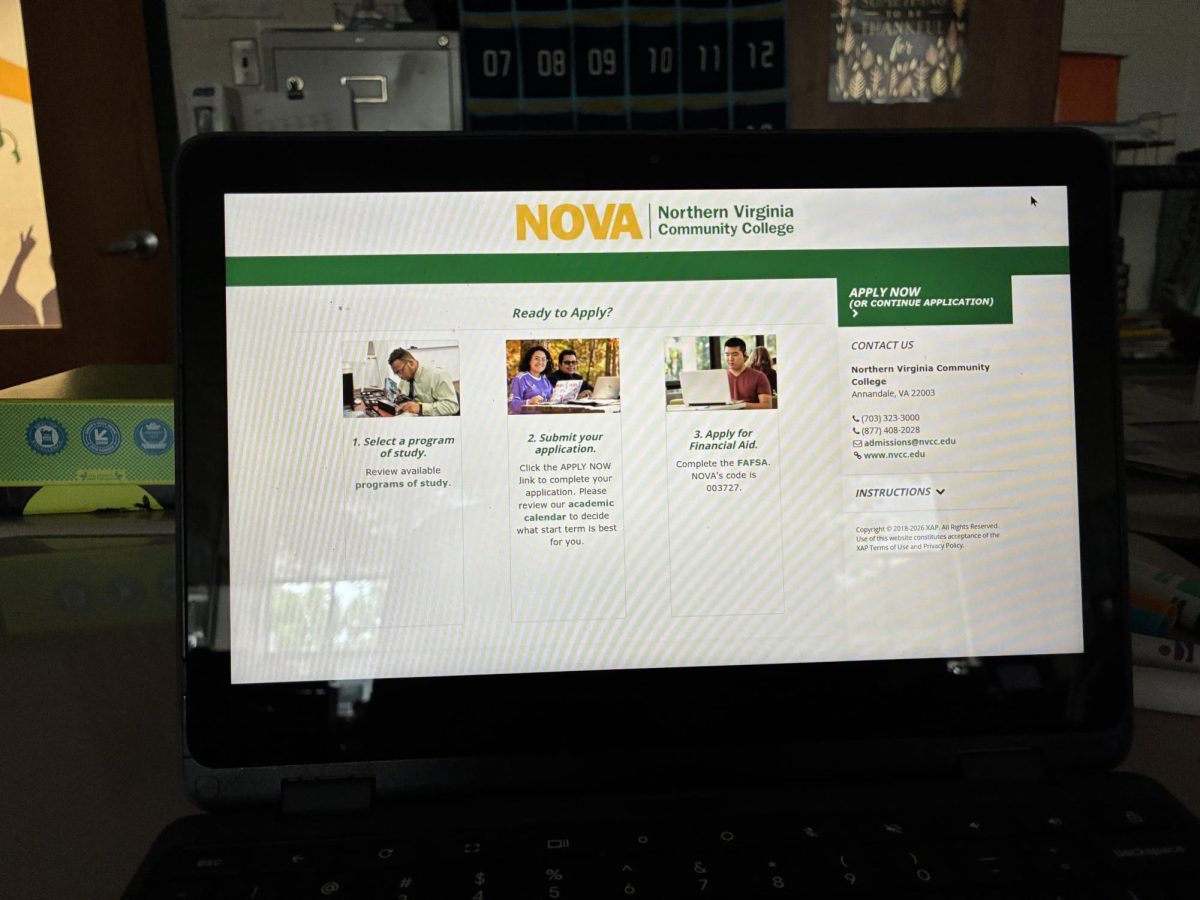
In Loudoun County, DE classes are primarily offered through Northern Virginia Community College, where high school students can earn graduation credits and college credit at the same time.
In contrast to AP, students do not have to take an exam to receive credit. DE classes can save students money and allow them to graduate faster when they attend college.
“DE is my favorite advanced course to take, as I’m guaranteed the same amount of college credit I would get from an AP class without the need to take an AP exam,” Ayres said.
With the availability of academic, honors, AP, DE and now IB classes, course selection at Valley has become increasingly convoluted. Extreme turnover in class availability year to year has made it difficult for students to be able to plan their courses ahead of time.
But Valley students continue to make adjustments and take advantage of the school’s commitment to providing a plethora of courses to choose from, hoping to assist students in preparation for whatever they plan to do post-graduation.
“The wide variety of classes is super beneficial because it pushes students to manage their time better,” Khan said. “Not just between classes but different roles and aspects of their identity. It also teaches students that determination will always outrun intelligence alone. If you put in the time, then you will succeed no matter what you do.”