The Washington Post, now owned by billionaire Jeff Bezos, laid off more than 30% of its staff in early February. The layoffs effectively eliminated the paper’s entire sports and books sections and dramatically reduced its foreign and local metro desks.
These layoffs are a continuation of Bezos’ upheaval of the paper. Tens of thousands of people cancelled their Post subscriptions after Bezos didn’t allow the editorial board to endorse presidential candidate Kamala Harris in the 2024 election, the first time in 36 years for the paper. This came shortly after the Los Angeles Times’ planned endorsement of Harris was blocked by owner Patrick Soon-Shiong, also drawing intense backlash from the public.
“My go-tos [media sources] used to be The Wall Street Journal and The Washington Post,” librarian Jef Mueller said. “For a long time, I would say The Washington Post and my views align pretty solidly. That’s not going to be the way anymore.”
Mueller worries about the influence of wealthy owners like Bezos occupied with their personal and political interests affecting the trustworthiness of the media..
“Whoever has the money and can produce on a large scale controls the narrative,” Mueller said. “Bezos has contributed to Trump’s inaugural fund, which is basically just a collection of money. The ballroom that’s being built is being privately funded by people in the media as well as other organizations. I think it’s buying influence.”
English teacher Shea Perry is also troubled by the implications of wealthy owners on the reliability of media sources.
“I know I’m at a point where I don’t even know where I can look for news that I trust,” Perry said. “I pretty much look outside of this country to see what other people are saying because I trust that more than what’s happening here.”
Perry has also noticed an increased reliance on social media in place of traditional news sources.
“People are taking little snippets that they’re seeing in social media that they call news that’s not really news,” Perry said, “instead of actually digging into longer pieces or pieces that journalists are writing that they’ve researched.”
Junior Alayna Khan worries that cutting funding and decreasing staff in newsrooms affects the media’s ability to monitor the government.
“It [layoffs] reduces the amount of government transparency that’s available,” Khan said. “And when you remove journalists and entire teams, that definitely takes away from the variety of perspectives that can be offered, especially in a time where we need to have those perspectives to be able to hold our government accountable properly.”
In the light of these firings at the Washington Post and the stress placed on the media, local news outlets have also been under fire, despite being an essential source of information to the people in their communities.
Local reporting is a major informative source to the public, as many readers are dependent on local newspapers to provide information on school board information, town events and zoning issues.
“I rely on print media,” Mueller said. “I rely on trustworthy sources to help me discern what to think.”
However, when met with a shortage of reporters, local news outlets with smaller, more concentrated audiences have been prone to turn into echo chambers, publishing biased or incomplete content.
“[Local papers] would be much less informed and be more apt to go to places like social media to get information that is not vetted,” Perry said. “And that’s scary.”
However, opportunities have arisen for local papers to start publishing online with Student Newspapers Online (SNO), which hosts The Viking News, as well as including more coverage from high school and college student reporters to help effectively reach greater audiences.
For example, students at the University of Michigan effectively began running the local Ann Arbor newspaper when its publication shut down, and local newspapers are already reliant on student media to cover events on public school campuses through interviewing and photography.
Diversifying the sources that one obtained news from is necessary to form a nuanced perspective, but becomes more and more challenging as local publications shut down because of a lack of reporters or funding.
“The whole point of journalism is to hone in on that variety of perspectives and be able to offer that lens of transparency,” Khan said.
Meanwhile, some local readers have noted the changes in reporting topics in recent times, with less focus being placed on local sporting and community events.
“It was easier to find a basketball score in the paper in 1995 than it is today,” chemistry teacher and basketball coach Chad Dawson said. “With all of the media that we have it’s very difficult to, as a coach, say: ‘Well, how did our competition do last night?’”
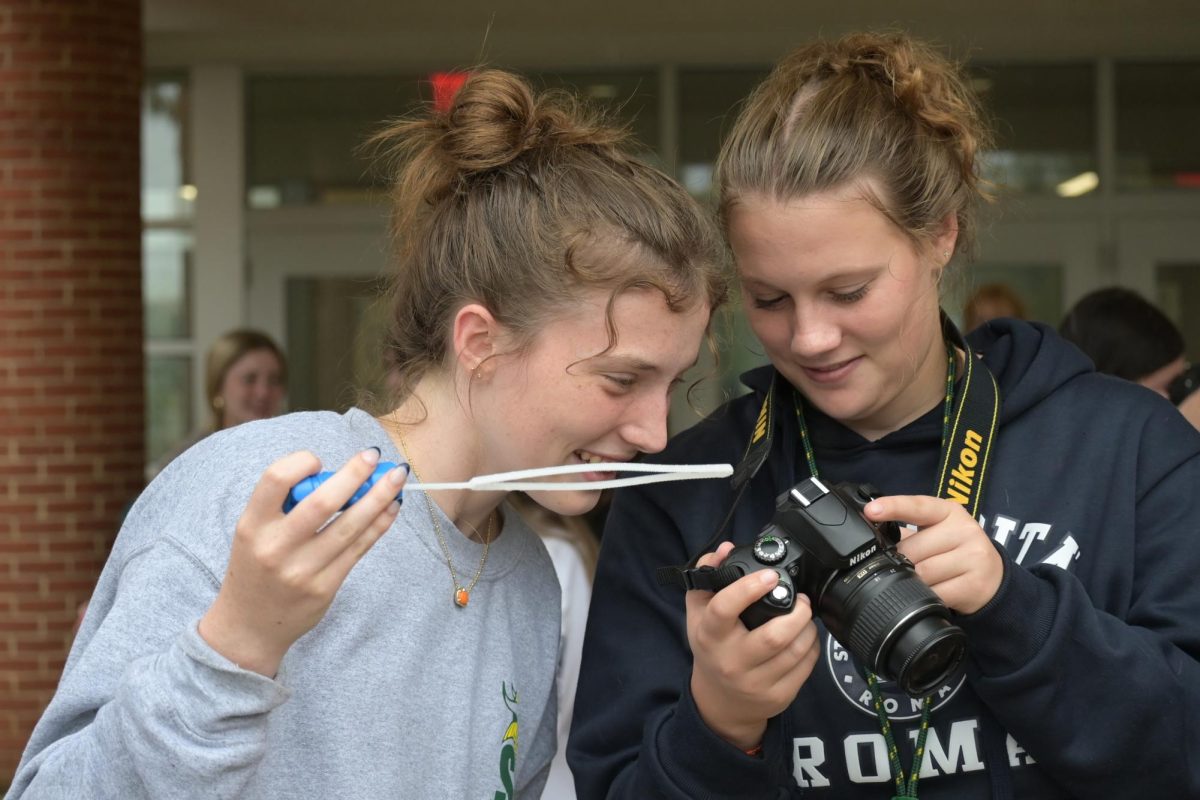
Because of newsroom cuts, sometimes it’s up to student journalists to spread awareness about the news to readers in a way that is unbiased, although the gaps in journalism can be a challenge for student journalists to overcome.
“If you have fewer journalists, then there’s not much inspiration for students to become journalists, and that kind of starts a waterfall,” junior Alayna Khan said. “Like a domino effect for people to remain in those echo chambers and not want to go out and view different perspectives.”
In an effort to support student journalism, LCPS has invested in equipment such as iPads and microphones for student journalists across the county. This kind of funding is vital to keeping student journalism alive in a time where journalism’s future is more uncertain than ever.
As more and more people shift away from mainstream news, it’s important for student journalists to receive help in any way possible. It is also important that news coming from student journalists remains nonpartial and as informational as possible, to ensure that journalism as a whole stays trusted over unreliable sources.
“If we just listen endlessly to social media and what other people are saying, that view distorts everything,” Mueller said.